
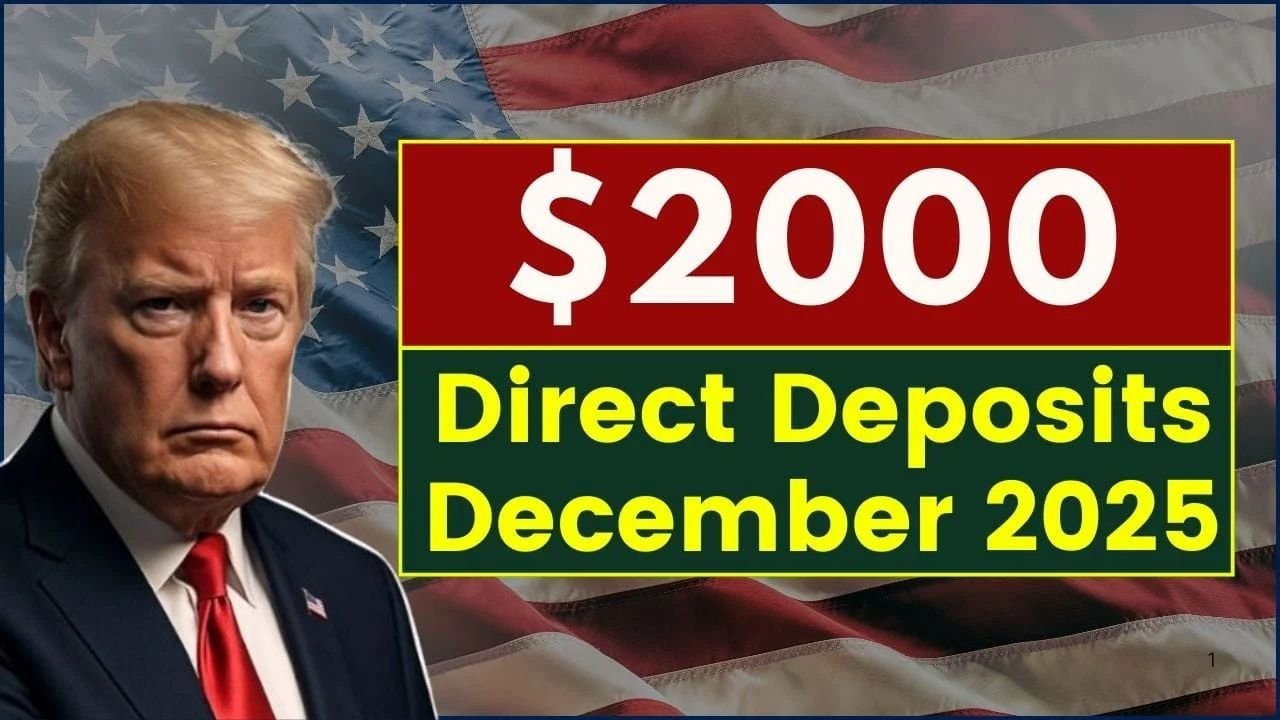
As social media posts and online articles circulate claims about $2,000 direct deposits in December 2025, federal authorities are urging Americans to separate fact from fiction. Despite widespread speculation, no new nationwide payment program has been approved by Congress or the IRS. Only routine benefit payments and tax refunds are scheduled, and any suggestion of a universal $2,000 deposit remains unverified.
What We Know About $2,000 Direct Deposits December 2025
Federal agencies confirm that there is no law or program authorizing a universal $2,000 payment. The Internal Revenue Service (IRS) and U.S. Department of the Treasury have not issued guidance, timelines, or eligibility rules for such deposits.
| Key Fact | Detail |
|---|---|
| Federal Approval | No legislation authorizing a universal $2,000 deposit |
| December Payments | Only regular benefits and tax refunds scheduled |
| Online Claims | Mostly speculative or misleading |

Treasury officials emphasize that any new direct-payment initiative would require congressional approval, proper funding, and formal administrative guidance. As of now, none of these steps have occurred. Economists note that the absence of official documentation—like a bill number, Congressional Budget Office score, or IRS notice—strongly suggests these payments are not imminent.
Why the Rumors Persist
The ongoing chatter about $2,000 deposits reflects a pattern dating back to the COVID-19 stimulus payments of 2020–2021, when Americans received multiple rounds of direct cash relief.
“People remember amounts like $1,200, $1,400, and $2,000 and associate them with federal assistance,” explains Dr. Elaine Morris, a public policy economist. “That memory makes misinformation easier to spread, especially during periods of economic uncertainty.”

Many online posts conflate:
- Routine benefit payments,
- Tax refunds and refundable credits,
- Political proposals that never became law, and
- Hypothetical stimulus scenarios.
This blend of fact and speculation has caused confusion, particularly among retirees and low-income households.
Eligibility: What Would Apply If a Program Existed
Since no federal program has been enacted, no official eligibility criteria exist. However, analysts suggest that if Congress authorized a payment, rules would likely mirror previous stimulus initiatives:
- Adjusted gross income limits based on filing status,
- Valid Social Security numbers or qualifying taxpayer identification,
- U.S. residency requirements,
- Recent tax return filings or participation in federal benefit programs.

Former IRS officials caution against assuming eligibility based on rumors. “Eligibility rules are written into law, and until legislation passes, there is nothing to qualify for,” a former senior administrator stated.
Beneficiaries Still Receiving December Payments
Although a universal $2,000 deposit is unconfirmed, millions of Americans will still receive legitimate federal payments in December 2025, including:
- Social Security retirement benefits,
- Supplemental Security Income (SSI),
- Social Security Disability Insurance (SSDI),
- Veterans Affairs (VA) pensions and disability compensation,
- Federal employee and military retirement payments,
- IRS-issued tax refunds and refundable tax credits.
In some cases, households may see combined payments approaching or exceeding $2,000. Federal officials clarify that this reflects scheduled benefits, not a new relief program.
State-Level Payments and Rebates
Another source of confusion comes from state-specific relief programs, which operate independently of federal initiatives. States have occasionally issued one-time rebates related to budget surpluses, inflation relief, or tax adjustments.
Mark Feldman, a state budget analyst, explains: “Announcements about state checks are sometimes mistaken for federal action. Each state program is separate, with its own eligibility and timing.”
State payments are announced through governors’ offices or revenue departments, not the IRS.
Economic Context: Why Stimulus Talk Resurfaces
Rumors of $2,000 deposits gain traction amid ongoing concerns over inflation, housing costs, and household debt. Although consumer prices have stabilized compared to pandemic peaks, essentials like food, rent, and insurance remain high.
Some lawmakers have suggested targeted relief measures, such as tax credits or expanded benefits, but no proposals have advanced into law. Analysts point to political and fiscal hurdles—including the federal deficit and divided government—as barriers to new universal payments.
Warnings About Scams and Misinformation
Fraudulent schemes often exploit rumors of $2,000 deposits. Scammers may impersonate IRS agents or government officials, requesting personal or banking information.
The IRS warns that it never:
- Contacts taxpayers via text or social media,
- Requests passwords or PINs,
- Charges fees to process payments.
Experts urge verifying any claims through official government websites or reputable news sources before taking action.
How to Verify Legitimate Information
To stay safe, experts recommend:
- Check official IRS, Treasury, or Social Security announcements,
- Rely on established national or international news outlets,
- Be skeptical of articles citing unnamed “government sources,”
- Avoid sharing personal data based on unverified claims.
Financial counselors emphasize that caution is essential when headlines promise guaranteed payments without official confirmation.
What to Watch Next
Any legitimate $2,000 direct deposit would follow a clear process: congressional legislation, public passage of a bill, presidential approval, and official guidance from the Treasury and IRS.
Until such steps occur, Americans should expect only regularly scheduled benefits and tax refunds. Future relief, if enacted, is more likely to be targeted rather than universal.
“As a rule of thumb,” said one budget analyst, “if a payment is real, you will hear about it first through official government channels—not social media.”
FAQs
Is there a confirmed $2,000 direct deposit for December 2025?
No. There is no federal law or IRS authorization for such a payment.
Why do some believe it is real?
Memories of prior stimulus payments, combined benefit totals, and misleading online content fuel the perception.
Could a payment be approved later?
Only Congress can authorize it, and no legislation has passed.
Do I need to apply or register?
No. There is no application process since no program exists.
Final Thoughts
The idea of $2,000 direct deposits in December 2025 remains speculative. While multiple federal and state payments may total near this amount for some households, no universal program exists. Americans are advised to rely on official sources and remain cautious of social media claims, protecting both their finances and personal information.